
Loading
Solar TAP
  • Home
  • Project
  • Partners
  • Network
  • Infrastructures
  • About us
  • Contact
  • Menu Menu
The “Solar Factory of the Future” (SFF) develops printing, coating, and patterning processes for high-throughput (HT) manufacturing of fully solution processed electronics, particularly of emerging photovoltaics (e-PV), utilizing its unique infrastructure, comprising roll-to-roll coating/printing, laser patterning, and encapsulation. The unique expertise of the SFF in the field of upscaling production processes of printed PV to a commercially relevant level originates from the combination of rational methods of ink formulation with smart coating and patterning procedures. As one of few research institutions worldwide, SFF is set up to provide module batch sizes up to the 100 m2 regime and has the competence to scale the output of its R2R processing line to the MW level. The combination of scientific expertise and technical competence positions the SFF to bridge the gap between laboratory research and industrial manufacturing regime. The SFF currently holds the efficiency world record for large area organic PV modules.

Solar Factory
of the Future

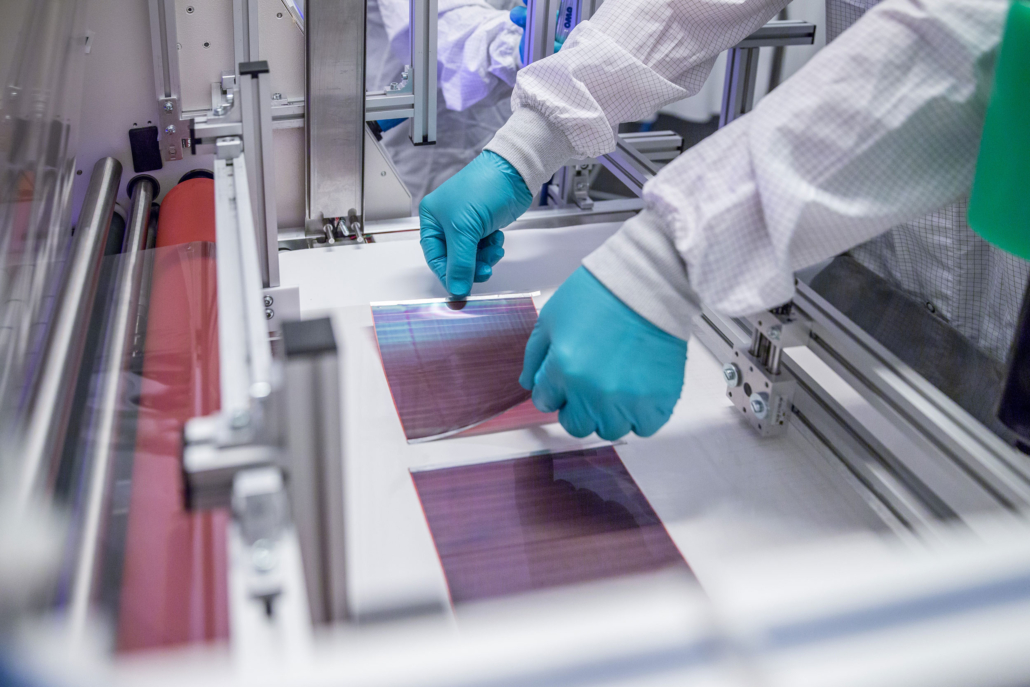
The Roll-to-Roll (R2R) slot die printing machine represents a key component in the Solar Factory of the Future, offering cutting-edge capabilities for the production of organic and perovskite solar modules.

Utilizing advanced slot die coating and laser processes, this industrial machine is capable of producing flexible solar modules at speeds of up to 2 meters per minute. It is perfectly suited for both the prototyping of large-scale solar modules and for high throughput material research.
BACK TO INFRASTRUCTURE
Flexible solar modules @ EnCN/Alisa Haas
1. Solar TAP Industry Day @ HI ERN/Kurt Fuchs

Overview

The R2R slot die printing machine is an industrial printing machine, which can produce organic and perovskite solar modules by slot die coating and laser processes on a flexible substrate with up to 2 m/min. This machine can be used for advanced prototyping of large-scale modules or high throughput material research.

Detailed Description

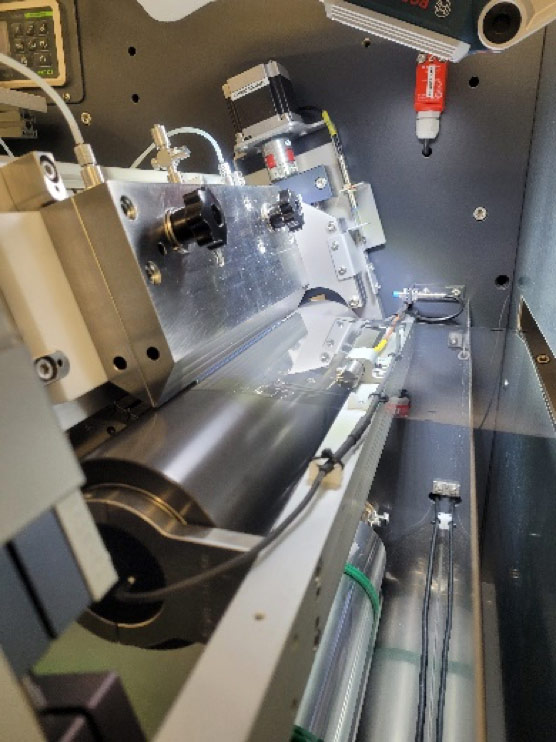
Purpose: Solar modules with industrial relevant processes and output can be produced in this infrastructure. The machine consists of three slot die stations, hot air an infrared ovens, web cleaning stations, a inline laser and bus bar lamination. All processes are optimized for a fast and reliable solar module production. Due to the usage of industry relevant processes and materials, perfect prototypes can be made.
In addition, the same processes can be used for material qualification and high throughput evaluation, including machine learning.


Videos

You are currently viewing a placeholder content from YouTube. To access the actual content, click the button below. Please note that doing so will share data with third-party providers.

More Information
Unblock content Accept required service and unblock content

You are currently viewing a placeholder content from YouTube. To access the actual content, click the button below. Please note that doing so will share data with third-party providers.

More Information
Unblock content Accept required service and unblock content

Unique Features

  • Up to 2 m/min printing with three heatable slot die stations (slot die, baking roll, tubes, syringes) and up to 8 m drying ovens per station
  • R2R on-the-fly ns-laser structuring
  • High throughput material research, by multi-nozzel slot die and gradient coating of active materials
  • Laminated modules with sizes up to 20 x 100 cm² can be produced and are ready for applications

Capabilities

  • 3 Slot Die Stations
  • Hot air and infrared ovens
  • Inline laser
  • Cleaning stations
  • Various layouts (and due to that voltages) possible, due to laser structuring
  • Semi-transparent modules possible with transparent AgNW electrodes
  • Inline Spectrometer and contactless sheet resistance measurement as QC
  • Rotary screen printer
  • Inline Bus Bar lamination

Diagrams or Schematics


Further information

https://www.hi-ern.de/de/forschung/hochdurchsatzmethoden-in-der-photovoltaik/hochdurchsatz-prozessierung-fuer-die-pv

BACK TO INFRASTRUCTURE

Contact Person

Helmholtz Institute Erlangen-Nuremberg, Forschungszentrum Jülich GmbH

Michael Wagner
mic.wagner(at)fz-juelich.de

CONTACT ME

Search

Search Search

Recent Posts

  • Solar TAP Featured as a Success Story in Germany’s Federal Energy Research Report 2026
  • Perovskite Solar Cells: From Research to Real-World Impact
  • Helmholtz Tech & Industry Day 2026
  • Solar TAP at HANNOVER MESSE 2026 | Connecting Research and Industry for Next-Generation Photovoltaics
  • Solar TAP nominated for the Endeavours Award 2026

Recent Comments

  • arderbor elnot on NGSE11 – Next Generation Solar Energy 2026
  • arderbor elnot on Energy Campus Nürnberg (EnCN)

Archives

  • October 2026
  • June 2026
  • April 2026
  • March 2026
  • February 2026
  • December 2025
  • November 2025
  • October 2025
  • September 2025
  • July 2025
  • June 2025
  • April 2025
  • March 2025
  • February 2025
  • January 2025
  • December 2024
  • November 2024
  • October 2024
  • September 2024
  • August 2024
  • June 2024
  • April 2024
  • December 2023
  • November 2023
  • July 2023
  • April 2023

Categories

  • Event review
  • Helmholtz
  • Interview
  • News
  • Prize
  • Science Highlight
  • Uncategorized

Meta

  • Log in
  • Entries feed
  • Comments feed
  • WordPress.org
© Copyright - Solar TAP - Energy Redefined
  • Legal Notice
  • Privacy Policy
Scroll to top Scroll to top Scroll to top